
2026-11-17
AI Could Boost Economic Growth but Disrupt Jobs: Fed Chair Warsh
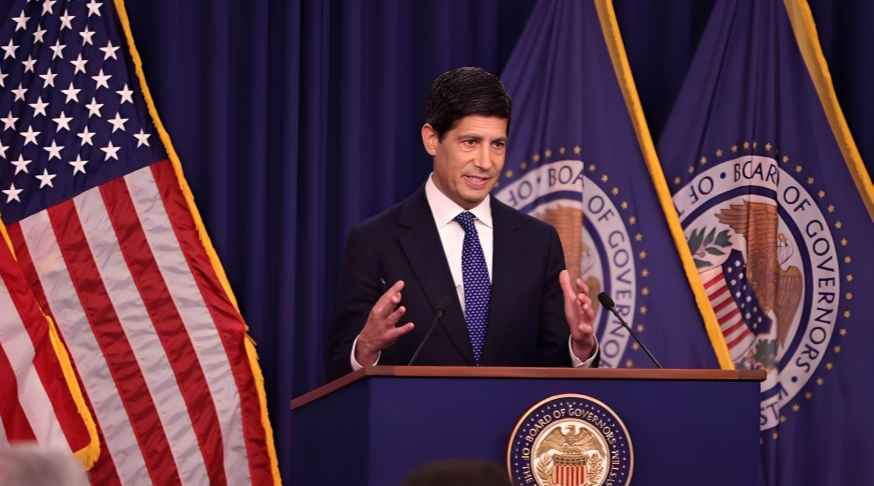
Federal Reserve Chairman Kevin Warsh on Monday said the emergence of artificial intelligence and what he described as “super intelligence” could fundamentally transform the US economy, potentially driving productivity growth, generating new ideas and reshaping the labour market.
Addressing the Productivity and Jobs Task Force Conference, hosted by the Federal Reserve Board and the Federal Reserve Bank of San Francisco in San Francisco, Warsh said the current period could be “the most transformational period in my adult lifetime.”
Highlighting the rapid advancement of super intelligence (SI), Warsh said access to advanced intelligence tools was becoming increasingly widespread, with the cost of satisfying human curiosity falling rapidly.
“Today, with the advances of SI, it’s happening. The marginal cost of satisfying limitless curiosity—on questions large and small—is falling fast, perhaps even trending toward zero,” he said.
Warsh emphasised that ideas remain the ultimate resource for economic growth, arguing that societies capable of generating and developing new ideas are more likely to prosper.
“In the tradition of endogenous growth theory in economics, ideas are the ultimate resource. If living standards are to advance, conditions must be favorable to the generation of new ideas,” he said.
He noted that despite a substantial increase in research efforts over recent decades, breakthrough innovations had become harder to achieve, with research productivity declining.
According to Warsh, super intelligence could distinguish itself from earlier general-purpose technologies such as electricity and the internal combustion engine by directly accelerating the process of idea generation.
“What might set SI apart, as an economic influence, is that it could supercharge idea generation. It appears to be changing the method—and the speed—of innovation,” he said.
He added that broader idea generation could sustain economic growth at levels substantially higher than historical averages.
However, Warsh cautioned against assuming that machines could replace human judgment and responsibility.
“Machines that can amass or even exceed human knowledge are still machines. They do not take the place of human judgment, morality, or responsibility.
Humans are the designers and the builders, and humans must be the deciders,” he said.
Raising questions about the strategic importance of the technology, Warsh asked, “Can you be a superpower without super intelligence?”
He said the Federal Reserve was examining the economic implications of the technology rather than advocating for or opposing its adoption.
Source: QATAR TRIBUNE