
2026-09-29
AIIB President Sets $20 Billion Annual Financing Target by 2030 at Doha Meet
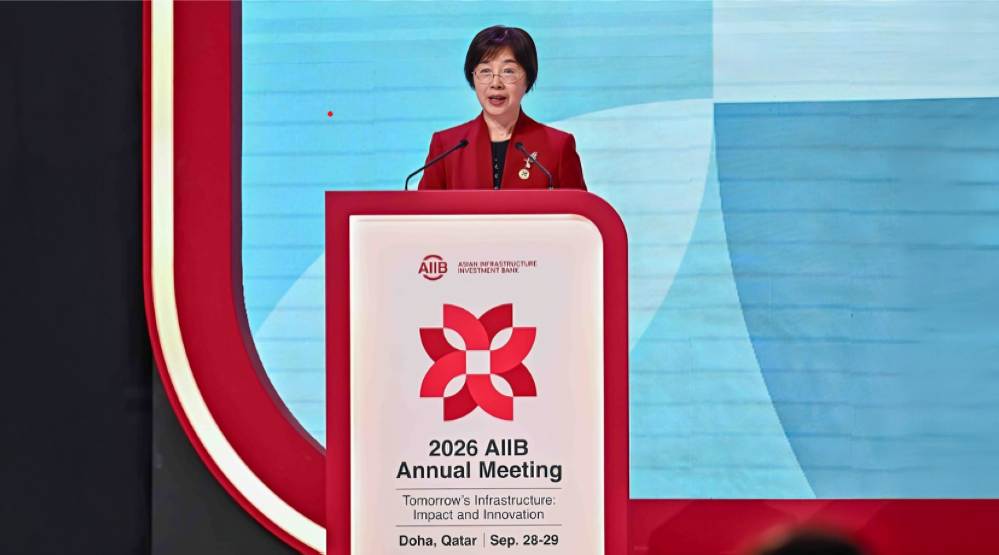
The Asian Infrastructure Investment Bank (AIIB) has set a target to double its annual financing to around $20 billion by 2030, as the multilateral development bank opened its 11th Annual Meeting of the Board of Governors in Doha on Sunday, marking its transition into a second decade of operations.
Held under the theme “Tomorrow’s Infrastructure: Impact and Innovation,” the annual meeting brings together Governors, senior government officials, business leaders, clients, partners and other stakeholders from around the world to discuss the future of infrastructure financing and sustainable development.
In her opening remarks, AIIB President Zou Jiayi outlined the AIIB’s priorities for its next stage of growth, stressing that infrastructure remains central to development, resilience and opportunity amid an increasingly uncertain global environment.
“The bank’s goal for the next stage is to scale up development impact with innovation and integrity,” Zou said. “We are builders. Together with our members and partners, let’s build trust, build connections and build Infrastructure for Tomorrow.”
Zou thanked Qatar for hosting the annual meeting and recognised HE Ali bin Ahmed Al Kuwari, Minister of Finance, as Chair of AIIB’s Board of Governors for 2026. She also highlighted Qatar’s role in bringing the Bank’s members together and keeping development at the centre of international cooperation.
Finance Minister Al Kuwari said Qatar welcomed AIIB members and partners to Doha and reaffirmed the country’s commitment to multilateral cooperation.
“As a founding member of AIIB, Qatar remains committed to advancing multilateral cooperation. We recognise AIIB’s contribution in supporting sustainable infrastructure development and fostering cross-border connectivity across its members,”he said.
“At a time when the world faces complex challenges, continued investment in sustainable infrastructure and practical cooperation is essential to support growth, resilience and shared prosperity,” Al Kuwari added.
AIIB enters its second decade with 111 approved members, a $100 billion capital base and a rapidly expanding infrastructure investment portfolio.
Since beginning operations in 2016, the Bank has approved more than $79 billion for over 400 projects across 43 economies, while maintaining AAA credit ratings from major international rating agencies.
Zou said the Bank’s next phase would focus on significantly scaling up its development impact, with the objective of doubling annual financing to about $20 billion by 2030.
The increased financing will focus on areas including climate-resilient infrastructure, renewable energy, digital transformation, regional connectivity, nature conservation and people-centred development.
She said the Bank’s approach would be guided by three principles — impact, innovation and integrity.
Impact, she explained, means increasing the development value generated by AIIB’s investments in areas where infrastructure needs remain substantial. Innovation involves adapting the Bank’s business model and financial instruments to better serve clients, while integrity means maintaining high standards, sound banking principles and adherence to the Bank’s mandate.
The Doha meeting is also examining how multilateral development institutions, governments and private-sector partners can respond to changing infrastructure requirements in the global economy.
A key focus is expected to be the mobilisation of private capital and deeper cooperation among financial institutions and markets to bridge infrastructure financing gaps.
“Development depends on international cooperation,” Zou said, describing AIIB as “a development partnership among equals.”
She said AIIB would continue working with its members and partners to mobilise capital, strengthen connectivity and support infrastructure projects capable of delivering tangible benefits to communities.
The Bank will maintain its focus on sustainable infrastructure in Asia and beyond while advancing what it describes as open regionalism to support infrastructure that connects economies, expands opportunities and contributes to sustainable development.
AIIB’s focus on climate finance is also growing. Seventy-one percent of its regular financing was climate-related last year, exceeding the Bank’s 50 percent target for the fourth consecutive year, highlighting the increasing role of climate considerations in its infrastructure portfolio.
The annual meeting comes at a significant point in AIIB’s development, as the institution moves into its second decade with an expanded membership and a growing portfolio.
The meeting is serving as a platform for member delegations, policymakers, business leaders, clients, partners, civil society organisations and other stakeholders to discuss AIIB’s strategic direction, operational priorities and future agenda.
AIIB’s Board of Governors comprises one Governor and one Alternate Governor appointed by each member, making the annual meeting the Bank’s principal governance and stakeholder engagementgathering.
Founded as a multilateral development bank focused on financing “Infrastructure for Tomorrow,” AIIB places sustainability at the core of its operations. The Bank works with partners to mobilise capital for infrastructure and other productive sectors aimed at supporting sustainable economic development and enhancing regional connectivity.
Source: QATAR TRIBUNE