
2026-08-20
China Launches Arctic Service Amid Middle East Tensions
As the Iran war spills over into the Red Sea – a crucial chokepoint for Asia-Europe trade – China has marked a milestone by launching its first regular service through the Arctic’s Northern Sea Route (NSR), a development welcomed by Russia.
The route, which runs along Russia’s northern Arctic coast, slashes travel time compared with alternative paths.
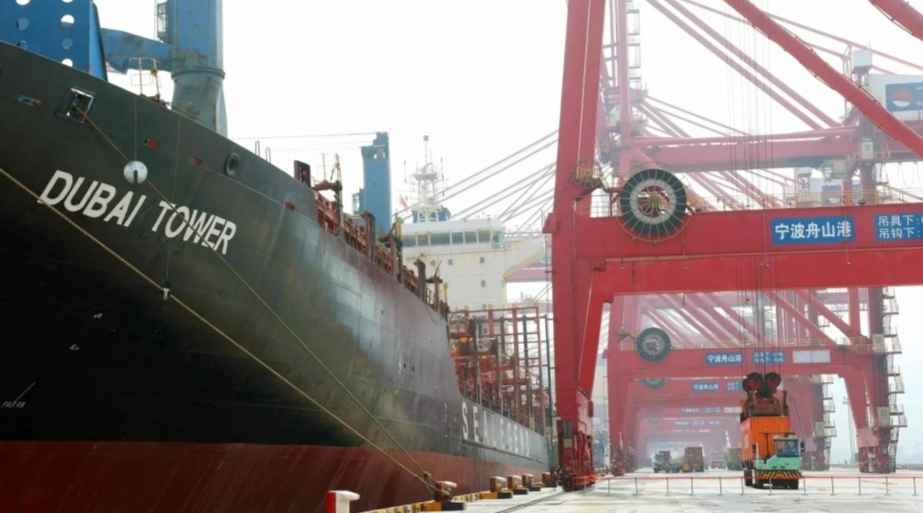
A journey from Ningbo city on China’s southeast coast to Felixstowe in the United Kingdom takes just 20 days – about half the time required for vessels transiting the Suez Canal through the Red Sea and five days faster than the land-based China‑Europe Railway Express, according to state-run news agency Xinhua. The inaugural ship on the regular service, the Dubai Tower, is transporting high-value-added cargo mostly produced across the Yangtze River Delta, including energy-storage cabinets, traction batteries, photovoltaic modules and new-energy components.
The operator, Sea Legend, told Xinhua that the vessel would make port calls in the Netherlands, Germany and Poland along its journey, which began on Saturday.
“When it comes to time efficiency and supply-chain security, the NSR delivers notable advantages,” Xin Jianning, general manager at Zhejiang Seaport Logistics Group, told the news agency.
“The route effectively circumvents both volatile transit times and mounting costs caused by geopolitical disruptions.” The launch comes as blowback from the US-Israeli war on Iran continues to threaten global shipping.
In July, Reuters reported that Tehran had asked Yemen’s Houthi militants to remain on standby to shut down oil shipping lanes in the Red Sea if the United States launched strikes on Iranian power infrastructure. The Houthis have since stepped up attacks, halting operations at a strategic seaport in Yemen and advancing towards the Bab al‑Mandeb Strait, a strategic shipping waterway, according to a Wall Street Journal report on Monday.
Commercial services on the NSR have expanded quickly following an initial pilot voyage in September 2025, with Sea Legend planning at least eight voyages this year. But the route remains seasonal, navigable only between July and October because of Arctic ice conditions, according to China Transport News, a publication overseen by the Ministry of Transport.
Two people familiar with the matter said shipping firm Sea Legend was in fact owned by Shanghai-based Worldwide Logistics, which is pursuing an initial public offering in Hong Kong.
An executive at Worldwide Logistics, speaking on condition of anonymity because they were not authorised to talk to the media, noted that NSR rates were significantly higher than standard China-Europe freight charges because of extra costs including ice-class reinforcement. “Even so, the maiden vessel sailed laden,” the executive said.
Freight rates for the China-Europe route via the Suez Canal stood at about US$4,500 per forty-foot equivalent unit (FEU), while NSR rates were nearly double that cost, ranging from US$8,000 to US$8,500 per FEU, said a Shanghai-based freight forwarder who requested anonymity because of business ties with Worldwide Logistics.
“To our understanding, the maiden vessel was booked by large direct shippers and not offered to the open market,” he added.
The expansion of the route aligns with broader strategic goals. In 2017, President Xi Jinping called for China and Russia to jointly develop Arctic shipping routes and build the “Polar Silk Road”.
Xinhua has framed the initiative as “highly significant for boosting shipping efficiency, safeguarding energy security and stabilising international supply chains.”
Under this framework, Moscow has granted access to Chinese cargo vessels. Alexey Likhachev, CEO of Russia’s state nuclear giant Rosatom – the body tasked with operating the NSR – confirmed in an August 7 interview with Strana Rosatom that the corporation had already issued navigation permits for Chinese vessels. Strana Rosatom is Rosatom’s official in-house publication. “The NSR’s roll-out is taking place against the backdrop of a persistently challenging situation in the Persian Gulf,” Likhachev said.
“The Chinese company’s initiative is further confirmation of the growing demand for our Arctic route and a logical step in the NSR’s development into a full‑fledged transport artery of global significance.” Rosatom became Russia’s sole operator of NSR-related infrastructure in 2018 and has since overseen its development.
According to a newsletter published on Rosatom’s official website in August 2025, government and business representatives from China and Russia had held regular meetings on joint activities related to the route.
Source: QATAR TRIBUNE