
2026-08-25
China, Switzerland Strike Trade Deal As EU Tensions Mount
China and Switzerland have concluded negotiations on the scrapping of tariffs on 99.8 per cent of Swiss exports, with analysts saying the deal carries more symbolic than economic weight amid growing trade tensions between China and the European Union.
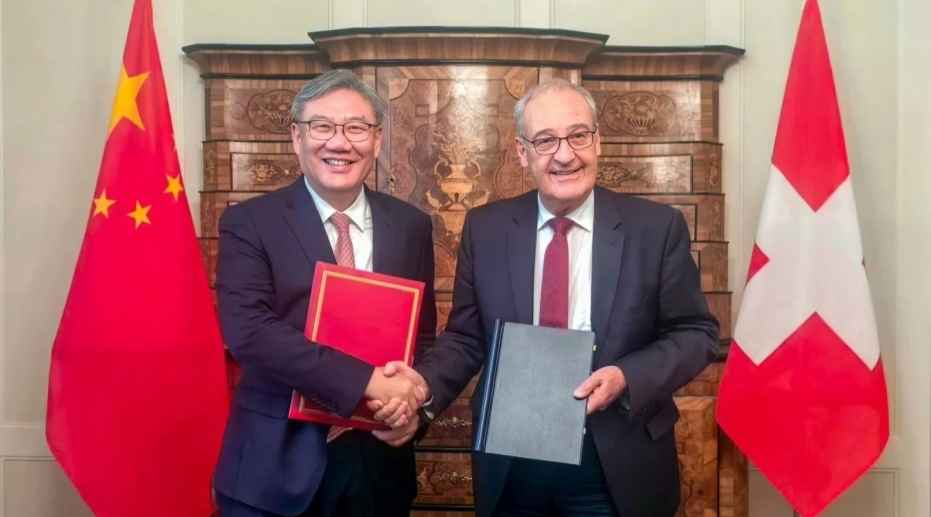
The agreement was announced by the Swiss side on Thursday after a meeting in Bern between Commerce Minister Wang Wentao and Swiss President Guy Parmelin. It will upgrade a 2014 free-trade agreement (FTA) under which only about half of Swiss exports to China were duty-free.
Wang said in a statement that the new FTA would create new opportunities for bilateral economic cooperation. “In the current international environment filled with uncertainty, this also demonstrates the clear stance of both sides in choosing certainty and supporting free trade,” Wang said.
For Beijing, the upgrade was a way to show that “close economic integration with China remains possible and attractive” for European countries, said Simona Grano, senior lecturer in Chinese Studies at the University of Zurich.
The timing was also “convenient from Beijing’s perspective”, said Noah Barkin, senior adviser at Rhodium Group. “It sends a signal to the EU at a time of heightened trade tensions that reduced barriers are possible.” The deal comes as Brussels presses Beijing to deliver “tangible results” by October to address trade imbalances, having already imposed a levy on low-value parcels and opened several anti-subsidy investigations. The bloc’s goods deficit with China reached €360 billion (US$420.5 billion) last year, or roughly €1 billion a day.
As a non-EU country, Switzerland had “traditionally pursued an independent approach towards China”, Grano said. China is Switzerland’s third-largest trading partner after the EU and the United States. Almost all Chinese exports to Switzerland are duty-free under the existing 2014 FTA.
Swiss exports to China were worth 15.2 billion Swiss francs (US$19 billion) last year, compared with 18.3 billion francs of imports, according to the Swiss State Secretariat for Economic Affairs. The figures exclude gold, which accounts for the bulk of Swiss shipments.
There were “clear economic benefits” for Switzerland, Grano said, pointing to sectors such as watches, machinery and pharmaceuticals. All three sectors will move to full duty-free coverage, from 1 per cent for watches, about 75 per cent for machinery and less than 30 per cent for pharmaceuticals, according to a fact sheet released by the Swissgovernment.
But only 77.5 per cent of Swiss exports will be duty-free when the deal takes effect, with the rest phased in over five to 10 years.
The additional tariff savings were estimated at about 244 million francs, the fact sheet said, equivalent to less than 2 per cent of Swiss goods exports to China. Given China’s regulatory and other non-tariff barriers, Grano added that tariff-free access also “does not necessarily mean unrestricted market access”.
The existing FTA mainly benefited multinational companies and large industrial firms, while smaller businesses often struggled with red tape and administrative costs, said Peter Bachmann, who was executive director of the Swiss-Chinese Chamber of Commerce in Shanghai from 2014 to 2023. Many Swiss companies already produced in China, he said, limiting the impact of tariff cuts on their sales in the country.
For Beijing, analysts said, the value of the agreement lay less in its economic impact than in the signal it sent. Bachmann described the upgrade as more of a “public relations” move for Beijing, allowing it to present the deal as evidence of stronger trade ties with other countries. Bern signalled interest in an upgrade as early as 2018, he noted, while Beijing only showed greater enthusiasm in the past two years.
According to the Swiss fact sheet, the pact contains the first reference to the Universal Declaration of Human Rights in a Chinese FTA, labour provisions that it said were new to China’s trade deals, and an environmental chapter it called the most ambitious Beijing had accepted.
The agreement also comes amid uncertainty over US trade policy. Washington imposed a 39 per cent tariff on Swiss goods in August last year, the highest rate on any Western economy, before cutting it to 15 per cent in November after months of negotiation.
Source: QATAR TRIBUNE