
2026-09-06
Fitch Reaffirms Qatar at ‘AA’ As Growth Outlook Strengthens
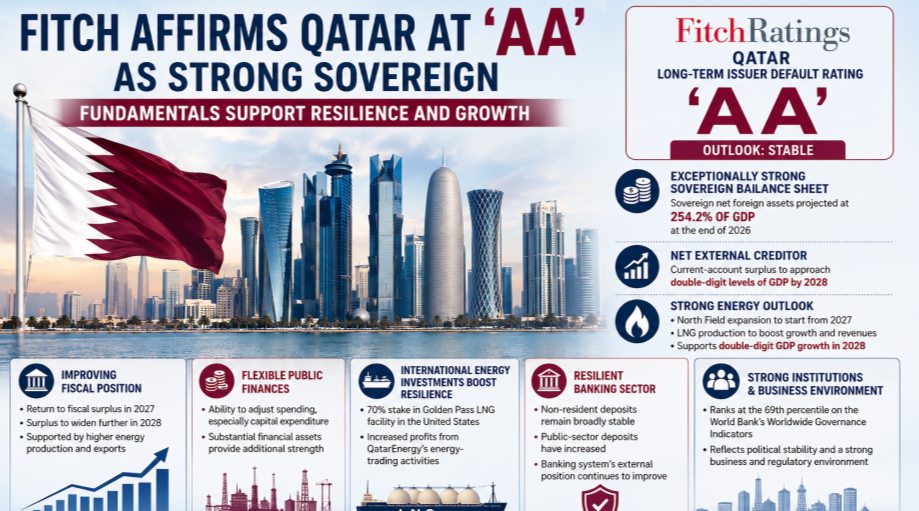
Qatar’s strong sovereign fundamentals and substantial financial buffers have been reaffirmed by Fitch Ratings, which has maintained the country’s long-term issuer default ratings at ‘AA’, highlighting the strength and resilience of the Qatari economy.
The rating reflects Qatar’s exceptionally high GDP per capita, large sovereign assets, flexible public finances and strong prospects for increased natural gas production in the coming years.
Fitch’s assessment underscores the depth of Qatar’s financial resources and the country’s ability to manage economic challenges while maintaining its long-term development and investment priorities.
A key strength identified by Fitch is Qatar’s exceptionally strong sovereign balance sheet. Sovereign net foreign assets are projected at 254.2 percent of GDP at the end of 2026, providing the country with substantial financial capacity and a strong foundation for future economic growth.
Qatar is also expected to remain a net external creditor during 2026. As energy exports recover, the country’s external position is projected to strengthen further, with the current-account surplus expected to approach double-digit levels as a share of GDP by 2028.
The outlook for the energy sector remains particularly strong. Fitch expects substantial additional production capacity from the North Field expansion to begin coming online from 2027. The increase in LNG production is expected to provide a major boost to economic activity and government revenues over the medium term.
The expansion is expected to underpin a strong recovery in economic growth, with further increases in gas production supporting double-digit growth in 2028.
Qatar’s fiscal position is also expected to improve significantly as energy production and exports increase. Fitch forecasts a return to a fiscal surplus in 2027, followed by a further widening of the surplus in 2028 as additional gas output comes on stream.
The country’s public finances benefit from considerable flexibility. Fitch points to the government’s ability to adjust spending, particularly capital expenditure, while Qatar’s substantial financial assets provide an additional source of strength.
The country’s international energy investments are also contributing to economic resilience. Fitch highlighted the contribution expected from the opening of the Golden Pass LNG facility in the United States, in which QatarEnergy holds a 70 percent stake, alongside increased profits from QatarEnergy’s energy-trading activities.
Qatar’s banking sector has likewise demonstrated resilience. Non-resident deposits have remained broadly stable, while public-sector deposits have increased and the banking system’s external position has continued to improve.
The rating agency also highlighted Qatar’s strong institutional and business environment. The country ranks at the 69th percentile on the World Bank’s Worldwide Governance Indicators, reflecting domestic political stability and a strong business and regulatory environment.
Taken together, the assessment reinforces Qatar’s position as a financially well-buffered, high-income economy with substantial long-term growthpotential.
The combination of large sovereign assets, expanding LNG capacity, strong external finances and a flexible fiscal structure provides a solid foundation for the next phase of Qatar’s economic development.
With North Field production expected to accelerate from 2027, Qatar is positioned for stronger energy revenues, renewed fiscal surpluses and robust economic growth in theyears ahead.
Source: QATAR TRIBUNE