
2026-11-12
German Economic Body Raises Annual Growth Forecast to 1.3%
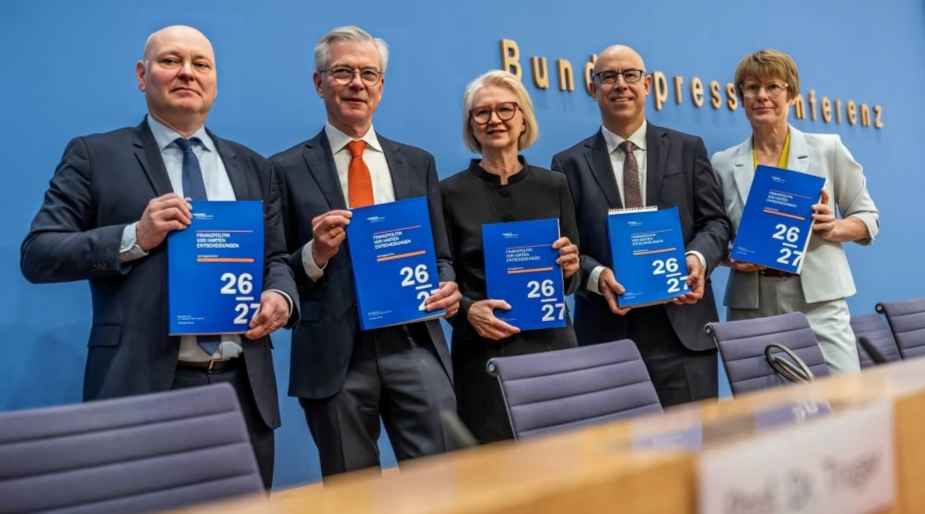
German gross domestic product (GDP) is expected to expand by an improved 1.3% this year and 1% in 2027, according to an upward revision by a leading panel of German economists.
The GDP increases predicted by the German Council of Economic Experts - the German government’s independent advisory body - would mark the first rise since 2022. The forecast is in line with those of other research institutes and the German government.
In its annual report released on Wednesday, the expert panel also warned of massive long-term budget shortfalls and challenges of “historic scale.” Council Chair Monika Schnitzer said politicians would be forced to make tough decisions, despite the economy’s current comparatively robust performance.
The German economy has recovered more quickly than expected from the “energy price shock” triggered by the war in Iran, according to the report. Exports, in particular, have performed better than expected.
Billions in additional government spending are also supporting growth. This includes debt-financed special funds for infrastructure modernization and climate measures, as well as higher defence spending.
Many research institutes and the federal government had already raised their growth forecasts.
The government also expects GDP to rise by 1.3% in the current year. In the spring, the Council, influenced by the consequences of the war in Iran, had forecast only minimal growth of 0.5% for the German economy in 2026, and a GDP increase of 0.8% for 2027.
Council wary of inflation, low productivity growth But rising energy prices are driving up inflation, according to the Council. Consumer price inflation is expected to reach 2.8% in 2026 and 3.3% next year.
The panel believes that economic growth is being held back by the low productivity growth among companies. They say that this could be boosted by new technologies and business models.
The economists had also previously highlighted high production costs, primarily due to rising social security contributions and energy costs. The German government is currently grappling with fundamental reforms, such as pensions. Last month, Economy Minister Katherina Reiche stressed the need for structural reforms. Growth is on shaky ground.
High debt is worrisome The Council sees Germany’s public finances coming under increasing pressure.
The federal government’s net borrowing is set to rise significantly by 2030 due to additional special funds and, above all, increased defence spending. It will remain high for an extended period.
Furthermore, federal spending has risen significantly since the early 2020s - driven by crisis-related additional expenses, expanded benefits under the social security system and higher subsidies.
Chancellor Friedrich Merz said at the handover of the report that the message regarding stable public finances had been received.
Germany is the only country among the G7 nations that still holds a triple-A rating. “I want it to stay that way,” Merz added. This top rating signals to investors that there is a very low probability of German government bonds defaulting. This enables Germany to borrow on favourable terms compared with many other countries.
The German Council of Economic Experts warns that the fiscal shortfall in the federal budget could amount to between 2.7% and 4.8% of GDP by 2040. Measured against last year’s GDP, that would be around €120 billion ($135 billion) or around €215 billion respectively.
According to the Council, the size of the deficit in the long term depends crucially on how quickly and to what extent debt financing of defence expenditure is scaled back. In its financial planning up to 2030, the Finance Ministry currently anticipates a budget deficit of around €50 billion in 2030.
A reduction in debt financing is necessary, said Schnitzer. Budgetary consolidation requires a package of measures. The economic experts cite the phasing out of environmentally harmful tax breaks - such as the energy tax relief on diesel fuel, for example.
In the medium term, tax increases may become necessary, as higher economic growth cannot realistically be expected to close the funding gap. There is also talk of a possible increase in the value added tax or VAT.
However, one of the five members of the Council, Veronika Grimm, had a different view. She argues that potential tax increases could reduce the pressure to fundamentally prioritize government spending and implement structural reforms.
Source: QATAR TRIBUNE