
2026-07-27
IBPC Qatar President Urges Strategic Trust for Asia’s Shared Future at Horasis Meet
Nearly 200 distinguished leaders from 36 countries and territories gathered at the Horasis Asia Meeting 2026 to explore the future of Asia amid a rapidly evolving geopolitical, economic and technological landscape.
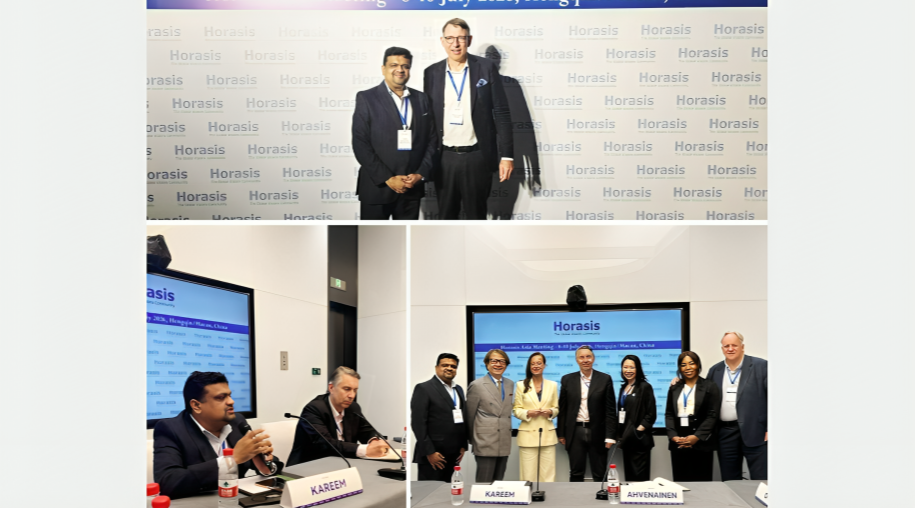
Among them was Thaha Muhammed Abdul Kareem, president of the Indian Business and Professionals Council (IBPC) Qatar under the aegis of the Embassy of India and Chief Strategic Advisor to the chairman, Wathnan Holding, who participated as a distinguished panelist in the session ‘Building Asia’s Shared Future: Cooperation in a Changing World’.
During the high-level dialogue, Thaha presented a strategic perspective on the future of regional cooperation, arguing that while Asia has successfully built deep economic interdependence over recent decades, the defining priority for the next decade must be the strengthening of strategic trust.
He said, “Asia has built economic interdependence. The next decade must build strategic trust.”
He observed that trade, investment, technology and integrated supply chains have connected Asian economies more closely than at any other point in history. However, in an era marked by geopolitical uncertainty, geoeconomic fragmentation and rapid technological transformation, economic interdependence alone is no longer sufficient to sustain long-term prosperity. Instead, he emphasised that durable growth will depend on trusted partnerships, resilient institutions, strategic dialogue and a shared commitment to regional cooperation.
During the discussion, Thaha highlighted three strategic priorities for Asia’s future: Transforming economic interdependence into enduring strategic partnerships; Leveraging Asia’s diversity as a strategic advantage rather than a source of division; Recognising trust as strategic infrastructure essential for investment, innovation and long-term regional stability.
Reflecting on Asia’s remarkable diversity of cultures, political systems and economic models, he noted that the region’s differences should not be viewed as barriers to cooperation but as a source of resilience and innovation.
“Asia does not need uniformity. It needs complementarity,” he said.
Drawing on his experience in the Gulf region, Thaha highlighted the Gulf’s growing role as a strategic connector linking Asia, Africa and Europe through investment, logistics, energy, innovation and finance. He noted that Asia’s future will increasingly be shaped by multiple centres of cooperation working together to create shared value across borders.
He concluded by emphasising that while competition among nations is inevitable, it should never come at the expense of cooperation, trust and long-term regional stability.
Thaha Muhammed Abdul Kareem was the only participant from Qatar, where he shared his perspectives during the high-level panel session.
Thaha expressed his sincere appreciation to Horasis Founder Dr Frank-Jürgen Richter and the Horasis team for their vision and leadership in building Horasis into one of the world’s most respected platforms for international dialogue, bringing together leaders from business, government, academia and civil society to foster collaboration, inspire innovation and advance practical solutions to shared global challenges.
Thaha’s participation also reflects IBPC Qatar’s commitment to promoting international business dialogue, strengthening economic and professional engagement, and contributing constructively to conversations that shape the future of Asia and the global economy.
Source: QATAR TRIBUNE