
2026-10-01
Industry-Linked Learning Vital for Qatar’s Future Workforce: Report
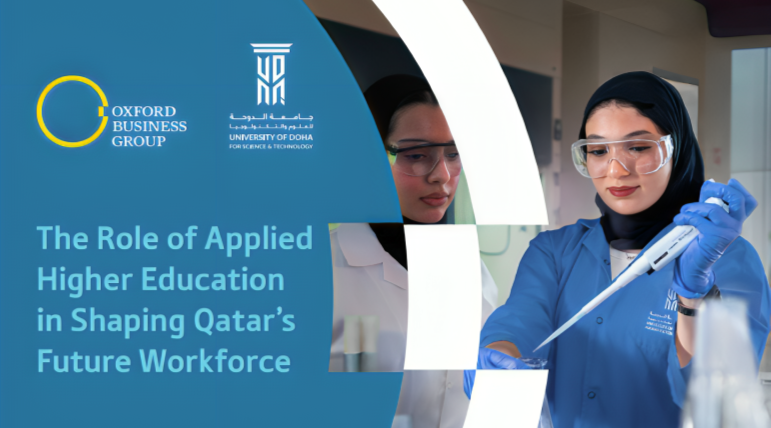
Oxford Business Group (OBG), in partnership with the University of Doha for Science and Technology (UDST), has released a new report examining the growing role of applied higher education in supporting workforce readiness, human capital development and long-term competitiveness in Qatar.
The report highlights how industry-linked learning can contribute to developing a highly skilled workforce aligned with the needs of a diversified, knowledge-based economy, in support of Qatar National Vision 2030 and the Third National Development Strategy.
Titled ‘The Role of Applied Higher Education in Shaping Qatar’s Future Workforce’, the publication explores how industry-linked learning, work-based training, and employer engagement can strengthen school-to-work transitions and help address skills gaps by aligning education more closely with labour market needs.
As Qatar expands investment in priority sectors such as digital technologies, logistics, aviation and health care, the report underscores that alignment between education systems and labour market demand is central to economic performance.
In this context, applied higher education is presented as a key mechanism for translating national diversification objectives into the technical, digital and soft skills required across a broader range of knowledge- and innovation-driven activities.
The analysis also considers the impact of structural shifts on workforce readiness, including the growing role of artificial intelligence and automation in production and services, alongside rising demand for green skills linked to sustainability commitments.
It highlights the importance of adaptable, interdisciplinary and transferable skills that can be deployed across markets, alongside stronger grounding in digital technologies, sustainability and innovation.
The report features an interview with Salem Al-Naemi, President of UDST, who underscores the importance of practical, market-relevant competencies in a technology-driven global economy.
“Applied higher education is central to building a future-ready workforce through nurturing practical, industry-relevant skills aligned with labour market needs,” Salem Al-Naemi said.“One key element is applied research, which is directly informed by industry priorities and designed to deliver practical outcomes.”
The report identifies opportunities to expand science, technology, engineering and maths education to meet rising demand for specialised skills, including in emerging technology and green economy segments.
It also points to the growing role of continuing professional education, micro-credentials and flexible pathways in enabling workers to upskill and reskill in response to evolving labour market requirements.
Commenting on the findings, Jana Treeck, Managing Director for the Middle East at OBG, said the analysis reflects broader shifts in how education systems are being positioned within economic strategies.
“As Qatar deepens its transition towards a knowledge-based economy, aligning skills development with labour market demand is becoming a critical determinant of productivity, innovation and competitiveness,” Treeck said.
The report concludes that embedding future-oriented capabilities within education systems, supported by stronger collaboration between institutions, industry and government, will be essential to ensuring Qatar’s workforce remains adaptable, internationally competitive and well positioned to support long-term diversification and development goals.
Source: QATAR TRIBUNE