
2026-09-07
Qatar Banking Sector Maintains Resilience As Total Assets Reach QR2.19 Trillion in July
Qatar’s banking sector continued to demonstrate resilience and underlying strength in July 2026, with total assets remaining broadly stable at QR2.194 trillion, up 2 percent compared with the end of 2025, while the sector maintained solid liquidity and recorded further growth in its overall loan book.
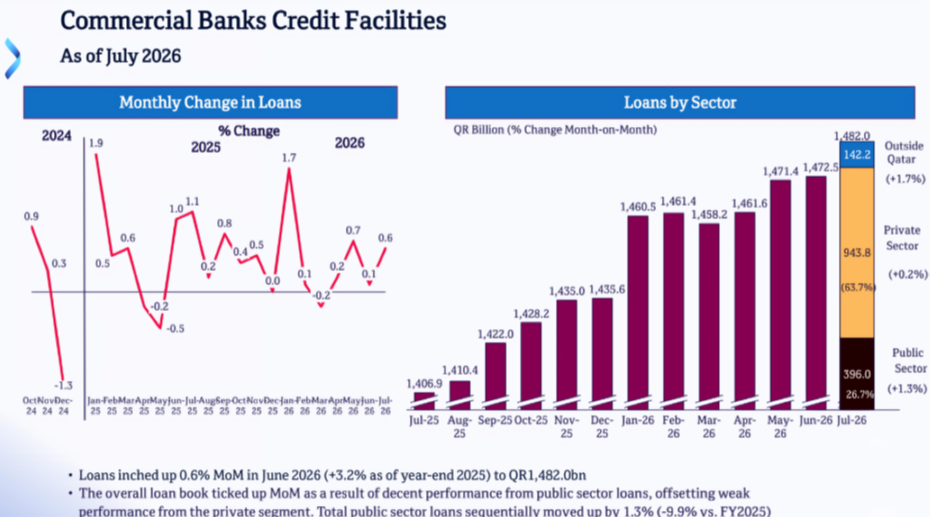
The latest banking sector indicators show that banks continued to support economic activity through steady credit expansion, even as deposits moderated during the month. The sector’s total loan book edged up 0.6 percent month-on-month (MoM) to QR1.482 trillion, representing a 3.2 percent increase from year-end 2025.
At the same time, total deposits stood at QR1.070 trillion at the end of July, following a 3.2 percent MoM decline, although deposits remained 2.5 percent higher than at the end of 2025. The combination of steady asset growth, continued lending expansion and strong liquidity underscores the banking sector’s capacity to support Qatar’s economic activity and investment pipeline.
The banking sector’s loan book recorded another monthly increase in July, with overall lending rising 0.6 percent MoM. The improvement was primarily driven by stronger lending to the public sector, which more than offset relatively subdued activity in the private-sector segment.
Public-sector loans increased 1.3 percent MoM in July. Within this segment, government loans rose 0.7 percent MoM and were particularly strong compared with the end of 2025, increasing 15.8 percent over the period.
Loans to government institutions, which account for around 51 percent of total public-sector loans, increased 1.6 percent MoM in July, while semi-government institutions posted an even stronger performance, with loans rising 2.1 percent MoM. The latter segment has increased by 20 percent compared with year-end 2025, highlighting continued financing activity across government-linked institutions.
Private-sector lending, meanwhile, remained broadly stable during the month, increasing around 1 percent compared with year-end 2025. Retail loans declined 1 percent MoM, but remained 2.3 percent above December 2025 levels.
Real estate lending, an important component of private-sector credit, increased 0.7 percent MoM in July, although it remained 2.6 percent below its December 2025 level. Lending across most other private-sector segments was generally stable.
Another notable growth driver was lending outside Qatar, which increased 1.7 percent MoM in July and has surged 58.6 percent since year-end 2025. The strong performance reflects the continued expansion of Qatari banks’ international lending activities.
Although deposits contracted during July, the banking sector’s overall deposit base remained comfortably above its position at the end of 2025.
Total deposits declined 3.2 percent MoM to QR1.070 trillion, but were still 2.5 percent higher than year-end 2025.
The decline was mainly associated with public-sector deposits, which fell 8.7 percent MoM in July. However, public-sector deposits remained marginally higher, by 0.6 percent, compared with the end of 2025.
Within the public sector, government deposits declined 2.1 percent MoM and were 11.2 percent below their year-end 2025 level. Deposits of government institutions fell 13.9 percent MoM, although they remained 3.3 percent above their December 2025 level.
Semi-government institutions recorded a comparatively modest 0.9 percent MoM decline, while their deposits remained significantly higher, at 17.2 percent above year-end 2025.
A positive development was the continued growth in non-resident deposits. These deposits increased 2.6 percent MoM in July and were 4.3 percent higher than at the end of 2025.
Non-resident deposits accounted for around 19.1 percent of total deposits, broadly stable compared with 18.8 percent at year-end 2025.
The continued presence of this funding source adds diversification to Qatar’s banking sector deposit base.
Private-sector deposits declined 1 percent MoM in July but remained 3.1 percent above year-end 2025, indicating that the underlying deposit base continues to show resilience.
Within the segment, deposits from companies and institutions declined 2 percent sequentially, but were still 2.7 percent higher than at the end of 2025.
Consumer deposits, meanwhile, remained stable during the month and were 5.2 percent higher than year-end 2025, pointing to continued strength in household liquidity.
Liquid assets accounted for around 30 percent of total assets in July, unchanged from May, June and December 2025. With loans growing while deposits declined during July, the conventional loan-to-deposit ratio (LDR) increased to 139 percent, compared with 133 percent in June and 137 percent in December 2025.
The banking sector also maintained a favourable trend in loan quality.
Loan provisions to gross loans remained stable at 3.8 percent in July, unchanged from the previous month and improved from 4 percent at year-end 2025.
The improvement compared with December indicates a strengthening provisioning position and provides an additional positive signal regarding the sector’s credit quality and resilience. Loan-loss provisions remained broadly stable during July and were 1.7 percent lower than at year-end 2025.
The QR2.194 trillion asset base remains close to record levels and is already 2 percent above year-end 2025. Meanwhile, the QR1.482 trillion loan book has expanded 3.2 percent since December, demonstrating continued demand for financing across key areas of the economy.
Source: QATAR TRIBUNE