
2026-07-20
Qatar Banks Maintain Strong Liquidity As Lending, Deposits Remain Resilient
Qatar’s banking sector continued to demonstrate resilience and stability in May 2026, with healthy loan growth, sustained deposit levels, strong liquidity buffers and improving funding metrics underscoring the sector’s solid fundamentals despite a marginal decline in totalassets.
According to the latest banking sector data released by QNB Financial Srvices (QNBFS), total assets of Qatar’s banking sector stood at QR2.191 trillion in May 2026, easing 0.7 percent month-on-month, but remaining 1.8 percent higher than at the end of 2025, reflecting the sector’s continued expansion on an annual basis.
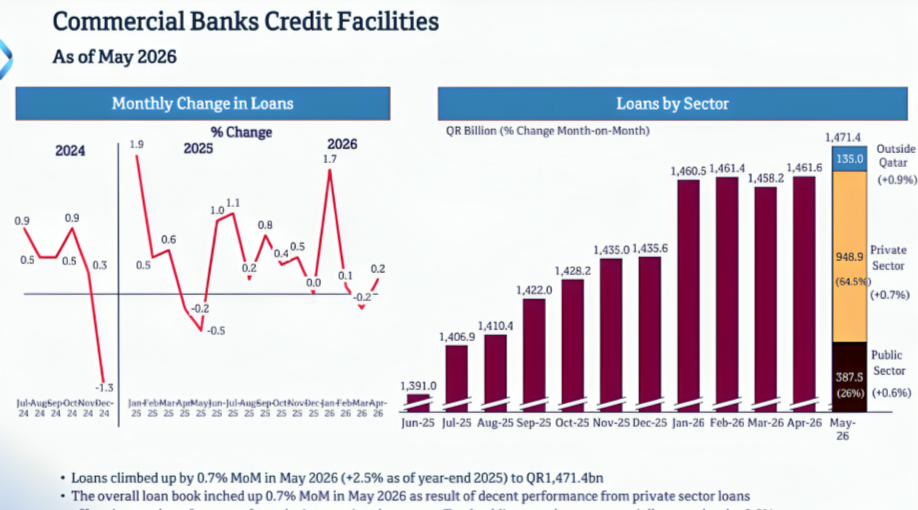
The banking industry’s total loan book increased by 0.7 percent during the month to QR1.471 trillion, extending growth to 2.5 percent compared with year-end 2025, while total deposits remained broadly stable at QR1.103 trillion, representing a healthy 5.6 percent increase from the end of last year.
The steady growth in loans alongside robust deposit inflows helped keep the sector’s loan-to-deposit ratio (LDR) unchanged at 133 percent, improving from 137 percent at the end of 2025. Importantly, under the Qatar Central Bank’s methodology, which incorporates stable sources of funding, the banking system’s LDR remains comfortably below the regulatory ceiling of 100 percent, highlighting the sector’s prudent fundingprofile.
A key driver of deposit growth was the public sector, where deposits rose 1.7 percent month-on-month and 6.8 percent compared with year-end 2025.
Within the segment, deposits from government institutions, which account for around 56 percent of total public sector deposits, recorded a strong 4.1 percent monthly increase and were 11.9 percent higher than at the end of 2025. Deposits from semi-government institutions also posted robust growth, rising 2.7 percent during the month and 13.4 percent year-to-date, demonstrating continued confidence from government-linked entities.
Although deposits from the government segment moderated by 3 percent during May, they remained a significant contributor to the overall funding base.
Private sector deposits also reflected stability, remaining unchanged during the month while recording a healthy 5.1 percent increase compared with the end of 2025. Deposits from both companies and institutions, as well as consumers, remained broadly steady during May, indicating sustained confidence among businesses and households.
Meanwhile, non-resident deposits declined modestly by 2.1 percent during the month but continued to remain 4.5 percent higher than at year-end 2025. Their share of total deposits held steady at 18.6 percent, reflecting continued international participation in Qatar’s banking system.
On the lending side, growth continued to be supported primarily by the private sector.
Private sector credit expanded 0.7 percent month-on-month and 1.6 percent since the end of 2025. The standout performer was lending to the industrial sector, which surged 7.7 percent during the month, signalling continued investment and business activity. Personal loans also recorded healthy growth of 1.9 percent, while lending across other segments remained broadly stable.
Public sector lending also edged higher by 0.6 percent during May. Lending to semi-government institutions recorded the strongest momentum, increasing 3.1 percent month-on-month and 14.8 percent compared with year-end 2025, while lending to the government segment remained stable and was significantly higher than at the end of last year.
International operations also continued to strengthen, with loans outside Qatar increasing 0.9 percent during May and posting an impressive 50.6 percent growth compared with year-end 2025, reflecting the growing regional and international footprint of Qatari banks.
Asset quality remained robust across the banking sector. The ratio of loan provisions to gross loans was unchanged at 4.1 percent, only slightly above 4 percent recorded at the end of 2025.
Loan loss provisions remained stable during the month and were 5 percent higher than at year-end, while Stage 3 loans continued to remain stable. Banks also maintained healthy provisioning buffers for Stage 1 and Stage 2 loans, reinforcing the sector’s resilience against potential risks.
Liquidity indicators continued to highlight the banking system’s financial strength. Liquid assets accounted for 30 percent of total assets in May, broadly unchanged from previous months and reflecting a consistently strong liquidity position that provides ample capacity to support future lending and economicactivity.
Overall, the QNBFS report said, the latest figures point to a banking sector that remains well-capitalised, highly liquid and supported by stable deposits, resilient credit growth and sound asset quality, reinforcing confidence in Qatar’s financial system amid a challenging global economic environment.
Source: QATAR TRIBUNE