
2026-10-14
Qatar Investors Show Strong Interest in UK Property
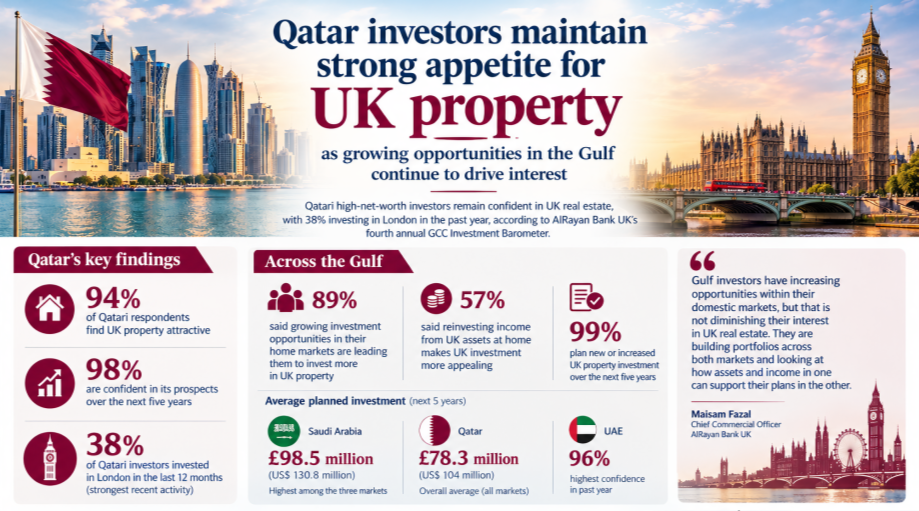
Qatari high-net-worth investors continue to show strong interest in the UK property market, with the growing range of investment opportunities in the Gulf encouraging wealthy individuals to expand their portfolios across both regions, according to the fourth annual GCC Investment Barometer by AlRayan Bank UK.
The survey found that 94 percent of Qatari respondents considered UK property attractive, while 98 percent expressed confidence in its prospects over the next five years, the highest levels among the three Gulf markets covered by the research — Qatar, Saudi Arabia and the United Arab Emirates (UAE).
Qatar also recorded the strongest recent investment activity in London, with 38 percent of respondents from the country saying they had invested in the British capital during the previous 12 months.
The findings highlight the continued appeal of the UK property market to Qatari investors even as investment opportunities expand within Qatar and the wider Gulf region. Rather than choosing between domestic and overseas markets, wealthy investors are increasingly looking to diversify their holdings and use assets and income generated in different markets to support their broader investment strategies.
Across the three countries surveyed, 89 percent of respondents said growing investment opportunities in their home markets were encouraging them to invest more in UK property. A further 57 percent said the ability to reinvest income generated by UK assets in their domestic markets made British property more attractive.
The report also points to sustained investment intentions among Gulf investors. Overall, 99 percent of respondents said they planned to make new or additional investments in UK property over the next five years. Among those intending to increase their exposure, the average planned investment stood at £78.3 million, equivalent to approximately $104 million.
Although the report did not provide a separate average planned investment amount for Qatar, Saudi Arabia recorded the highest average among the three markets, at £98.5 million, or around $130.8 million, over the next five years.
The UAE, meanwhile, recorded the strongest improvement in investor confidence over the past year, with 96% of respondents saying their confidence in UK property had increased. The corresponding figure was also 96 percent in Saudi Arabia, while Qatar’s distinguishing features were its high overall confidence in the market and its recent London investment activity.
Maisam Fazal, Chief Commercial Officer at AlRayan Bank UK, said the expansion of investment opportunities in Gulf markets had not diminished investors’ interest in British real estate.
“Gulf investors have increasing opportunities within their domestic markets, but that is not diminishing their interest in UK real estate. They are building portfolios across both markets and looking at how assets and income in one can support their plans in the other,” he said.
Fazal added that investment intentions had remained consistently high across four years of research, although investors were increasingly scrutinising income potential, costs and the quality of individual opportunities before committing capital.
For Qatar, the findings point to continued interest in international real estate as part of the investment strategies of wealthy individuals, alongside opportunities available in the domestic market. London’s continued presence in Qatari investment activity also underlines the importance of established overseas property destinations for investors seeking geographic diversification.
However, the report highlights the need for greater transparency and reliable professional guidance as cross-border property investment becomes more complex. Among respondents across the three markets, 37 percent identified high fees or hidden costs as a challenge, while 36 percent said they found it difficult to distinguish trustworthy advice from guidance influenced by commercial interests.
These concerns suggest that investors are paying closer attention not only to potential returns but also to transaction costs, the reliability of advisers and the long-term quality of assets. For investors operating across Qatar and the UK, understanding the financial implications of holding property overseas and transferring income between markets remains an importantconsideration.
Fazal said investors’ priorities varied, but transparent costs and advice that took account of both Gulf and UK markets were consistentlyimportant. The 2026 GCC Investment Barometer was based on research involving 150 respondents in Qatar, Saudi Arabia and the UAE, each with at least £10 million, or approximately $13.3 million, in wealth and/or assets.
The findings provide an indication of investment sentiment among high-net-worth individuals in the three Gulf markets, rather than the wider population of property investors. While the survey points to continued interest in UK real estate, actual investment decisions will depend on individual investors’ assessments ofopportunities, costs and expected returns.
Source: QATAR TRIBUNE