
2026-08-09
Qatar Property Market Resilient As Home Sales Up 23.6% in Q2
Qatar’s real estate market demonstrated notable resilience in the second quarter of 2026, with a sharp recovery in residential sales and a significant increase in mortgage activity highlighting continued confidence in the country’s property sector despite regional uncertainties.
According to the latest Qatar Real Estate Research – Second Quarter 2026 report by ValuStrat, residential sales transactions rose 23.6 percent quarter-on-quarter and 15.8 percent year-on-year, reaching 755 transactions during the three-month period.
The median residential transaction value also strengthened, rising 4.5 per cent quarter-on-quarter and 8.2 percent annually to approximately QR3 million.
The performance suggests that buyers remained active and that demand for property continued to provide an important pillar of stability for Qatar’s wider real estate market.
The positive residential picture was reinforced by strong mortgage activity.
Qatar recorded 335 mortgage transactions across ready properties during the second quarter, representing a 15 percent quarterly increase and an 8 percent annual rise.
The total value of mortgage transactions reached QR16 billion, up 9 percent from the previous quarter and a substantial 61 percent higher than a year earlier.
Doha municipality remained the leading centre for mortgage activity, recording 139 transactions worth QR14.2 billion.
The combination of higher transaction volumes and rising mortgage values provides an encouraging indication of activity in the residential sector.
Residential capital values showed limited movement during the quarter, reinforcing the market’s overall stability.
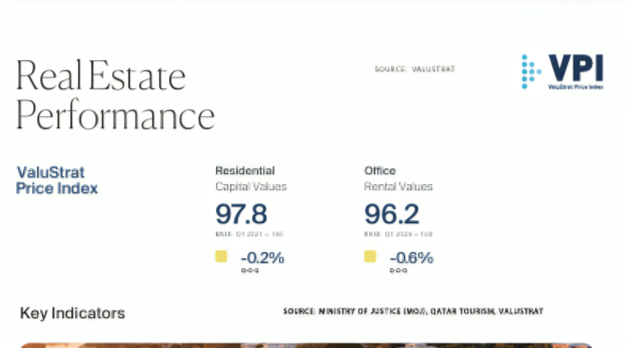
The ValuStrat Price Index stood at 97.8 points in the second quarter of 2026, with apartment and villa values broadly unchanged.
Apartment capital values averaged QR10,460 per square metre. The Pearl recorded an average of QR10,570 per square metre, followed by Lusail at QR10,365 and West Bay Lagoon at QR9,460.
Villa capital values averaged QR5,675 per square metre and remained stable year-on-year.
Residential gross yields also remained steady at 5.6 percent, with apartments delivering an average gross yield of about 8 per cent, compared with 4.4 percent for villas.
Qatar’s residential stock reached 406,097 units during the second quarter, comprising 257,271 apartments and 148,826 villas.
Around 355 apartments were delivered during the quarter, while approximately 4,600 residential units are scheduled for completion during the second half of 2026.
More than 600 units have been deferred to 2027, mainly in Lusail, pointing to a more measured approach to project delivery and potentially helping the market adjust to changing levels of demand.
The office sector presented a more selective picture, but high-quality space continued to attract demand.
Grade A office rents recorded 1.6 percent annual growth, while Lusail emerged as a particularly strong performer, recording 4.5 percent annual rental growth.
ValuStrat reported that semi-government entities continued to consider moves into higher-quality offices, including premium developments such as The Pearl. The trend highlights continued demand for modern, efficient and high-quality commercial space even as occupiers remain cautious about expansion.
Qatar’s retail market also showed signs of improvement during the quarter.
Total retail supply remained stable at 5.7 million square metres of gross leasable area, with no significant new retail completions recorded.
Retail activity improved following a softer first quarter, supported by a series of major events, promotions and seasonal activities, including Eid Al-Adha promotions, the Amir Cup, Sneaker Con Doha, the Indian Mango Festival, the Qatar Outlet Exhibition and the Doha Summer Trade Fair.
Several retailers also expanded their presence, adding further variety to Qatar’s shopping destinations.
The hospitality sector faced greater pressure during the second quarter, with approximately 0.6 million visitor arrivals recorded during the quarter.
However, GCC tourism provided an important source of support. GCC visitors accounted for 40 percent of total arrivals, with GCC visitor numbers increasing 11 percent quarter-on-quarter.
Domestic tourism initiatives, including Hala Summer and Kids Go Free, were also highlighted as efforts to stimulate visitor activity.
Despite challenges affecting several sectors, Qatar’s property market continued to demonstrate an ability to absorb uncertainty and adapt to changing conditions.
The strongest signal came from residential real estate, where higher sales volumes, rising transaction values and increased mortgage activity combined with broadly stable property values.
ValuStrat described the market as resilient in the second quarter, with the 23.6 per cent quarterly increase in home sales providing a key anchor for overall market performance.
As Qatar moves into the second half of 2026, the market appears increasingly defined by stability, selective growth and stronger activity in high-quality assets. The latest figures suggest that, despite external uncertainties, underlying confidence in Qatar’s real estate sector remains intact.
Source: QATAR TRIBUNE