
2026-09-01
Qatar’s Non-Hydrocarbon GDP Grows 3.5% in Q1 2026
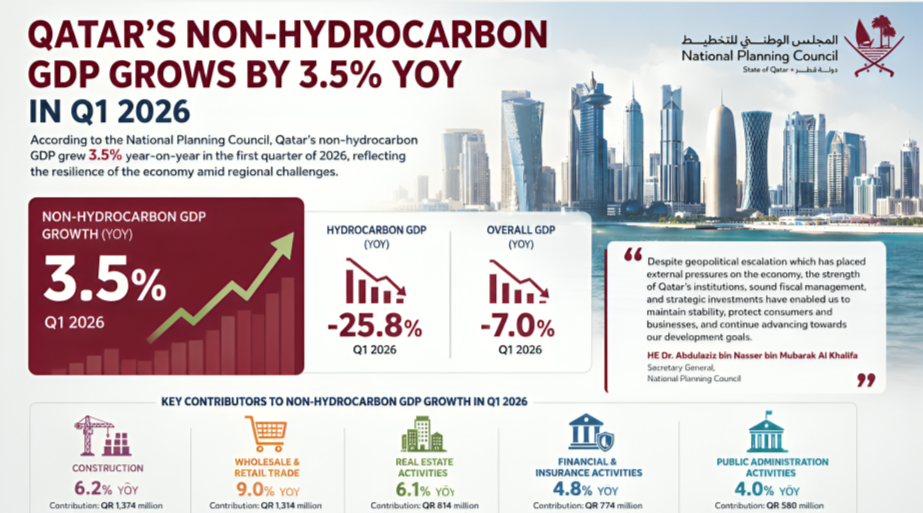
Qatar’s non-hydrocarbon Gross Domestic Product (GDP) grew 3.5 percent year-on-year in the first quarter of 2026, according to the National Planning Council (NPC), reflecting the resilience of the Qatari economy and the strength of its diversified economic base despite challenging regional and global conditions.
The latest GDP data released by the NPC showed that the non-hydrocarbon sector continued to record positive growth despite disruptions affecting regional shipping and trade routes, higher transportation and insurance costs, and increased pressures on global supply chains.
The NPC said the latest results demonstrate the resilience and economic stability of Qatar and reflect the effectiveness of measures implemented to safeguard the economy, maintain market stability and ensure the continuity of essential goods and services.
Commenting on the report, Secretary General of the National Planning Council Dr Abdulaziz bin Nasser bin Mubarak Al Khalifa said recent indicators demonstrated the resilience of the Qatari economy and the effectiveness of the country’s long-term strategic planning.
“Despite geopolitical escalation which has placed external pressures on the economy, the strength of Qatar’s institutions, sound fiscal management, and strategic investments have enabled us to maintain stability, protect consumers and businesses, and continue advancing towards our development goals,” he said.
According to NPC data, the strong performance of non-hydrocarbon activities was driven by broad-based growth across several key sectors, led by wholesale and retail trade, construction, real estate, financial and insurance activities, and public administration.
The wholesale and retail trade sector recorded the highest growth among the major contributors, expanding 9 percent YoY and adding QR1.314 billion, equivalent to 1.1 percentage points, to real non-hydrocarbon GDP growth.
The construction sector grew 6.2 percent YoY, contributing QR1.374 billion, or 1.2 percentage points, while real estate activities increased 6.1 percent, adding QR814 million, or 0.7 percentage points.
Financial and insurance activities rose 4.8 percent YoY, contributing QR774 million, or 0.7 percentage points, while public administration activities grew 4 percent, adding QR580 million, or 0.5 percentage points, to non-hydrocarbon growth.
However, the NPC noted that the positive performance of non-hydrocarbon activities was offset at the overall economy level by a sharp contraction in the hydrocarbon sector. Hydrocarbon GDP declined 25.8 percent YoY in Q1 2026, resulting in a 7 percent contraction in Qatar’s overall GDP during the quarter.
The NPC said recent restrictions affecting shipping and exports in the region contributed to the decline in hydrocarbon activity and placed additional pressure on the wider economy.
Despite these challenges, the council highlighted Qatar’s ability to maintain an uninterrupted supply of essential goods and services, while government entities coordinated efforts to monitor market conditions, preserve supply chain continuity, support economic activity and minimise the impact of external disruptions on citizens, residents and businesses.
The NPC said the contribution of non-hydrocarbon sectors underscores the strong economic foundations built over recent years and Qatar’s increasingly diversified economic base, in line with the objectives of Qatar National Vision 2030.
Source: QATAR TRIBUNE