
2026-09-02
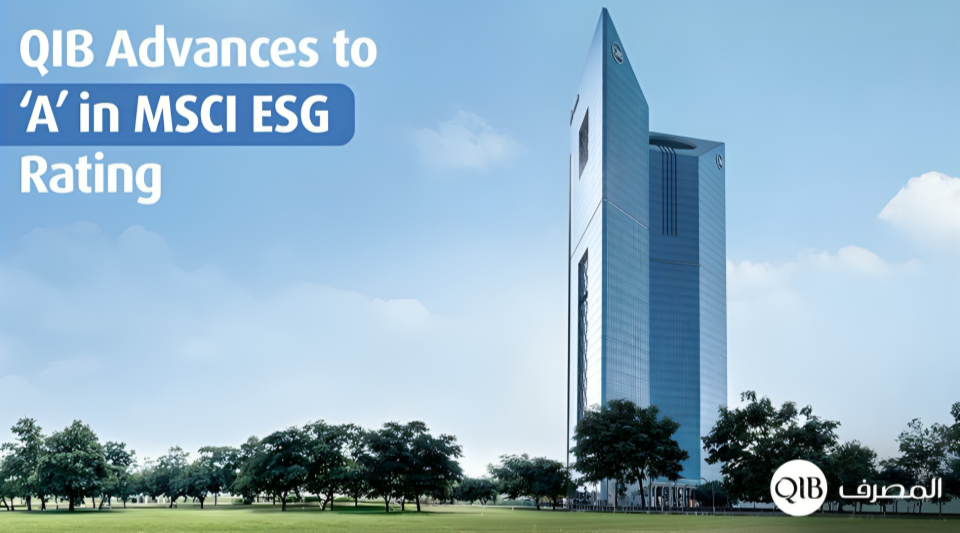
QIB Climbs to ‘A’ in MSCI ESG Ratingon Stronger Sustainability Performance
Qatar Islamic Bank (QIB), Qatar’s leading bank, has achieved an upgrade in its MSCI ESG Rating from BBB to A, as of August 2026, marking the fourth consecutive year of improvement in the Bank’s ESG rating levels. With this latest assessment, QIB is one of the highest rated organisations in Qatar, reflecting the Bank’s sustained commitment to advancing its environmental, social and governance (ESG) practices.
QIB’s rating has advanced steadily to A over the past years, driven by the bank’s strategic priority of adopting global best practices in Corporate Sustainability. This consistent progress reflects QIB’s strategic investment across multiple fronts — strengthening governance structures at Board and management level, embedding ESG considerations into risk management and product development, adopting new data and monitoring capabilities, and enhancing the depth, quality and transparency of its sustainability disclosures.
QIB has driven these advancements over the past years through close collaboration across all departments, embedding sustainability considerations into the Bank’s strategy, governance, risk management, product development and day-to-day operations.
The latest assessment recorded considerable improvement in QIB’s Industry Adjusted Score for the banking sector, demonstrating tangible developments in the way ESG considerations are integrated and managed across the Bank, among peers.
The Environmental Pillar showed the most significant improvement, supported by stronger ESG integration into sustainability-related financial product development, enhanced ESG due-diligence triggers and risk escalation processes, and closer involvement of Credit Risk in the bank’s ESG Risk Management.
QIB also recorded considerable improvement in the Social Pillar, driven by progress across aspects of Human Capital Development, Privacy & Data Security, Consumer Financial Protection and Access to Finance.
Commenting on the rating upgrade, QIB Group CEO Bassel Gamal said, “We are pleased to achieve an ‘A’ Rating in MSCI’s assessment, reflecting our continued efforts to further embed responsible practices across the Bank. This milestone encourages us to build on our progress, further advance our ESG practices and continue creating long-term value for our employees, customers, shareholders and the local community.”
MSCI ESG Ratings measure a company’s resilience to long-term, industry-specific sustainability risks using a rules-based methodology. MSCI Sustainability and Climate measures, benchmarks and monitors, sustainability and climate performance versus peers across 10,000 + corporate issuers, collecting thousands of data points for each company.
This upgrade strengthens QIB’s credibility with a growing base of international and regional ESG-focused investors, many of whom incorporate MSCI ESG Ratings directly into their screening, portfolio construction and engagement processes. The result reinforces QIB’s alignment with Qatar Central Bank’s Sustainability Reporting Framework and the sustainability priorities of Qatar National Vision 2030.
Ultimately, the rating signals to shareholders, regulators and customers that QIB manages ESG considerations not only as a compliance obligation, but as a core driver of long-term resilience and value creation.
The upgrade also highlights QIB’s continued efforts to strengthen its sustainable finance offering and incorporate ESG principles into its broader business strategy. By integrating environmental and social considerations into financing decisions, risk assessment and product development, the Bank is seeking to support responsible economic activity while responding to the evolving expectations of customers, regulators and investors.
The improved rating further underscores QIB’s focus on transparency and accountability, as the Bank continues to enhance its sustainability reporting and monitoring frameworks. The progress is also aligned with Qatar’s broader sustainability agenda and the financial sector’s increasing emphasis on responsible banking, climate-related risks, social impact and sound corporate governance.
Source: QATAR TRIBUNE