
2026-11-08
Vietnam’s Growth Will Depend on Domestic Economy’s Integration
Vietnam has become one of the standout growth stories of the global economy in recent years. In the third quarter of 2026, real GDP expanded 9.95% year-on-year, the fastest quarterly pace in four years, bringing growth for the first nine months to 9.01%. This acceleration builds on an expansion of 8.02% in 2025, already the strongest performance since 2011.
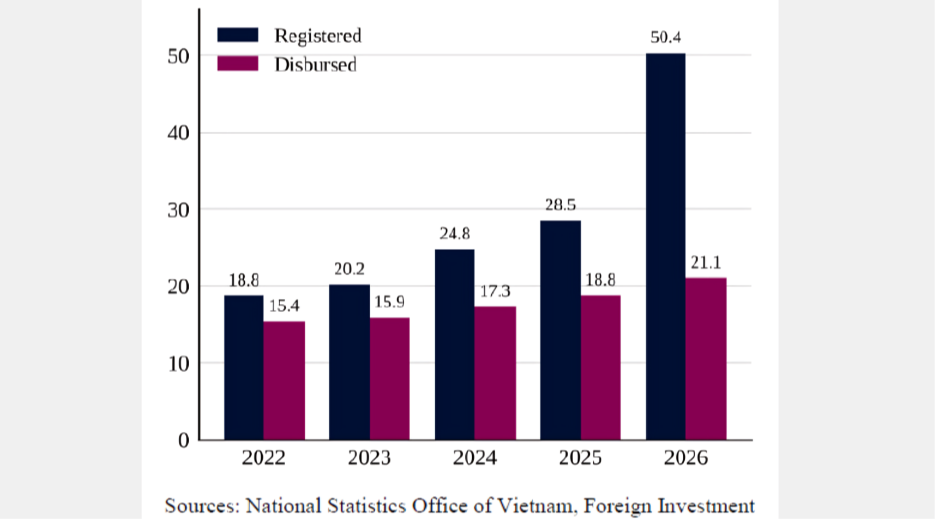
The momentum has been underpinned by a historic pipeline of foreign direct investment (FDI), with registered commitments rising 76.4 percent to $50.4 billion in the first nine months of the year, while disbursements reached their highest nine-month level in five years.
These achievements have been recognised internationally, as the World Bank reclassified Vietnam as an upper-middle-income economy in July 2026. With the government targeting annual growth of at least 10 percent through 2030, Vietnam is increasingly viewed as Asia’s next “tiger” economy, following the path once travelled by Korea and Taiwan.
However, a closer look at the composition of growth reveals an economy running at two speeds. The boom is concentrated in a foreign-owned, export-oriented manufacturing sector, as FDI firms account for most of Vietnam’s high-tech exports and of the imported components and machinery needed to produce them. Domestic firms, by contrast, remain largely confined to assembly, processing and ancillary supply activities with low value added.
This reliance on imported inputs is visible in trade data: in the first nine months of the year, imports grew 36.7 percent, outpacing exports at 24.5 percent, partly reflecting higher energy prices, with China the largest source of imports at $187.3 billion. In our view, while Vietnam’s growth is set to continue, its sustainability will depend less on the next wave of foreign investment than on the ability of domestic firms to capture a larger share of the value it creates.
In this article, we discuss three factors that will determine whether the benefits of foreign investment spread to the broader economy: the structure of the FDI-led export sector, the quality of the new wave of technology investment, and the strength of domestic demand.
First, the FDI-led export sector remains weakly connected to the rest of the economy. According to the National Statistics Office, foreign investment continues to flow overwhelmingly into manufacturing, which absorbed $17.40 billion or 82.6 percent of the $21.07 billion disbursed in the first nine months of the year. Yet linkages with local suppliers remain weak.
Over the same period, foreign-invested firms accounted for 80.7 percent or $350.41 billion of the total $434.30 billion exports. On the other hand, foreign firms also imported $335.55 billion of goods into Vietnam, including machinery for new plants. This indicates that most inputs are sourced abroad and then exported by foreign firms. Domestic firms are largely not part of this supply chain and generate less value domestically and there are only limited spillover effects for the local economy. This structure leaves Vietnam exposed to external shocks, including US trade scrutiny, as it already faces an additional 12.5 percent US tariff on part of its exports and one ongoing Section 301 investigation.
Second, a new wave of foreign investment is shifting towards higher value-added activities, offering greater potential for spillovers. Investment is increasingly directed to semiconductors, artificial intelligence (AI), data centres, as well as research and development (R&D). Planned projects include a $1 billion advanced chip-packaging plant and a $2.1 billion AI data centre in Ho Chi Minh City. Unlike traditional assembly, these activities require skilled engineers, specialised services and local research capacity, creating opportunities for domestic firms and workers to move up the value chain.
The government is supporting this shift with generous financial incentives for semiconductor and R&D projects. However, absorption capacity remains a constraint, as shortages of skilled workers, regulatory bottlenecks and limited land and specialised infrastructure are risks that could delay execution. Registered FDI rose 76.4 percent this year, while disbursements rose only 12.1 percent, suggesting much of the pipeline has yet to materialise.
Third, the domestic economy is gaining momentum, acting as a balancing factor for growth. In the first nine months of the year, final consumption grew 8.5 percent, while capital formation rose 17.8 percent. Public investment is playing a central role, as the government accelerates hundreds of large-scale infrastructure projects worth an estimated $200 billion, with state budget investment up 19 percent in the first nine months. Better infrastructure lowers logistics costs and connects domestic firms to markets. Business dynamism is also improving, with close to 111,700 new firms registered in the first half, up 22.5 percent . Unlike exports, these domestic engines are less exposed to US trade measures, partly offsetting the vulnerabilities of the foreign-led sector.
All in all, Vietnam’s growth is set to continue, but its quality will depend on the domestic economy. The export boom remains largely captured by foreign firms, while the new wave of technology investment and stronger domestic demand offer an opportunity to deepen local linkages. Seizing it will require investment in skills, faster project execution and stronger local suppliers.
— By QNB Economics
Source: QATAR TRIBUNE